Compare
Cervica vs ChiroFusion, from lived experience
By Dr. Daniel Turner, DC · Reviewed September 2, 2026
This page is different from most comparison pages because we did not research ChiroFusion. We lived in it: three clinics, years of daily use, and eventually a migration off it using the same importer your practice would use. That experience earns ChiroFusion real credit, and it makes the criticisms specific.
First, give ChiroFusion its due
ChiroFusion is honest value. It is genuinely inexpensive, fully web based before that was standard in chiropractic, and it covers the fundamentals: scheduling that works, notes that get signed, claims that go out. Thousands of smaller practices run on it and many should stay. Our practice ran three offices on it for years and collected real revenue through it the whole time, which is more than nostalgia; it is the reason the rest of this page can be specific instead of vague.
The three ceilings, exactly where we hit them
1. Denials wait for a human to notice
In ChiroFusion, a denial is a line on a remittance. Somebody has to see it, decode the adjustment reason, research the fix, and rework the claim, per claim, forever. At low volume that is manageable; at three offices of insurance volume it became the single largest leak in the practice. Cervica routes every denial to a specific fix automatically, which is not a feature so much as the reason the product exists. The denial library is that routing logic, published.
2. The percentage of collections math
ChiroFusion’s answer to billing depth is its managed billing service, advertised around 6 percent of collections. The arithmetic deserves daylight: 6 percent of $40,000 monthly collections is $2,400 a month, $28,800 a year, forever, and it scales up with your success. Cervica’s position is structural: the billing tools live in the flat price and we never take a percentage of collections.
3. Growth: providers, locations, and PI
Adding providers and a second location strained workflows built for one of each, and the personal injury book never had a home at all: liens, settlements, and statute deadlines lived in spreadsheets beside the EHR. Cervica ships multi location scheduling and reporting and the full PI module inside the same system, because those were our own growing pains.
See the difference
The denial worklist we built because reports were not enough

Cervica, the actual product. This screen exists because our clinics lived the alternative. Every denial lands translated, triaged, and one click from its fix.
The same job in ChiroFusion
- ·Denials appear in claim reports; working them means reading raw adjustment codes line by line
- ·Our three clinics ran it for years, which is why we can describe the workflow from memory
- ·The gap between recording a denial and working it is where the low sticker price gets expensive
A billing day, end to end
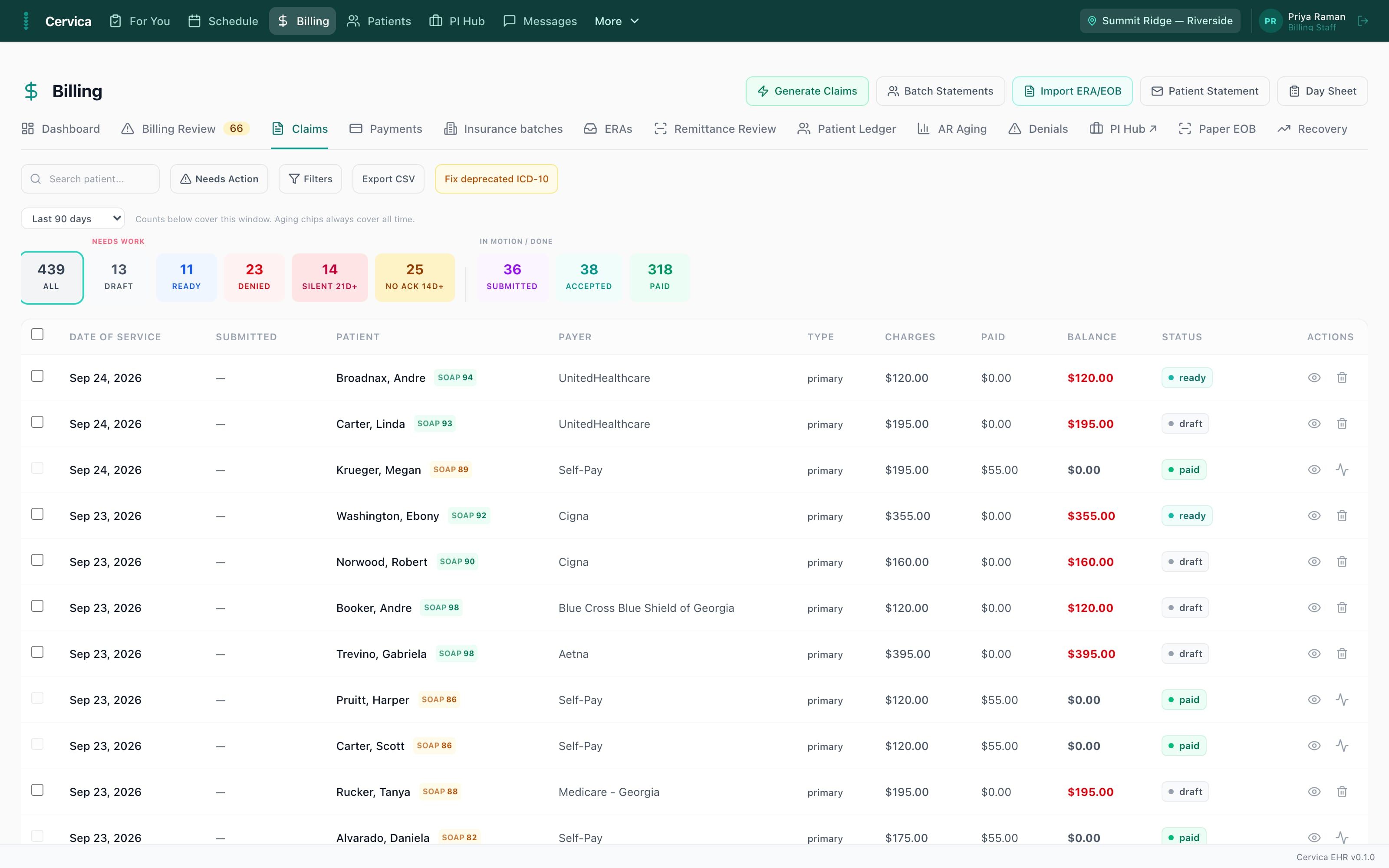
Cervica, the actual product. Claims, payments, remittances, and AR aging in one place; ERAs are retrieved and matched automatically for biller review and posting.
The same job in ChiroFusion
- ·Claims and payments are recorded competently; posting and follow up lean on the biller
- ·The optional billing service takes a percentage of collections to do that work for you
- ·At real volume the percentage often exceeds every flat priced option on the market
Side by side
| ChiroFusion | Cervica | |
|---|---|---|
| Price shape | Low subscription; optional billing service around 6 percent of collections | Flat monthly, published in full; billing tools included, never a percentage |
| Denials | Arrive on remittances; a human notices, researches, reworks each one | Worklist reads every adjustment code and routes each denial to a fix |
| Eligibility | Manual checking against payer portals | Real time checks before the visit, refreshed automatically |
| Personal injury | No case management; spreadsheets beside the system | Full module: liens, settlements, records, statute watchlists |
| Growth | Built for smaller single location practices | Unlimited providers on Practice plans; multi location scheduling and reporting |
| Texting | Reminders covered; ask about two way texting and metering | Two way texting per location included, never metered |
Switching, from the practice that did it
Our migration ran both systems in parallel: a cutover date for new visits, old claims winding down in ChiroFusion over 60 to 90 days, and the two systems reconciled against each other, collections, AR, and balances, before the old one dropped to read only. A single office practice compresses the whole arc into 30 to 60 days. The importer that moved our demographics, insurance, and balances is the one your practice would use, and the week by week plan is written out in the switching guide.
The decision checklist
- ✓Multiply your monthly collections by the billing service percentage and stare at the annual number
- ✓Count last month’s denials and ask who worked each one, and at what hourly cost
- ✓If PI matters, ask where the liens and statute deadlines live today
- ✓Price your three year roster on both platforms
- ✓Run a Cervica sample data evaluation in parallel; your ChiroFusion export makes that a two week experiment, not a leap
Questions practices ask
Is ChiroFusion good software?
For the basics, yes. It is affordable, web based, and covers scheduling, notes, and claims well enough that thousands of smaller practices run on it happily. Our founding practice ran three offices on it for years. The ceilings appear with growth: rising billing volume that needs real denial work, added providers and locations, and personal injury books that outgrow spreadsheets.
How much does ChiroFusion cost?
ChiroFusion sells a low cost software subscription with an optional managed billing service advertised at a percentage of collections, around 6 percent per public materials. The subscription is genuinely inexpensive; the percentage is where the real money lives. A practice collecting $40,000 a month pays roughly $28,800 per year at 6 percent, which buys a lot of flat priced software with billing tools included.
Is it worth switching from ChiroFusion?
Stay if the basics are all you need and the price fits. Consider switching when denials pile up with nobody routing them, when a second provider or location strains the workflow, or when PI cases live in spreadsheets. Those were exactly the three pressures that led our founding practice to build its replacement.
How hard is it to get data out of ChiroFusion?
Workable, from direct experience. Patient demographics, insurance, and balances export in usable form, and PDF chart exports carry the clinical history. Cervica’s ChiroFusion importer is the one our own practice used for its three office migration, including reconciling both systems against each other before trusting the new one.
How long does switching from ChiroFusion take?
Our own three office migration ran on a parallel plan: a cutover date for new visits, 60 to 90 days of old claims winding down in ChiroFusion, and reconciliation between the systems before the old one dropped to read only. A single office practice compresses that to 30 to 60 days comfortably.
Does ChiroFusion handle personal injury?
It has no integrated PI case management: no lien tracking, settlement workflow, attorney directory, or statute watchlists. PI practices on ChiroFusion track cases outside the system. Cervica ships the full PI module in the same system as the chart and claims, and that gap is a large part of why Cervica exists.
What is the biggest difference between Cervica and ChiroFusion?
What happens after the claim. ChiroFusion records billing; denials arrive on remittances and wait for a human to notice, research, and rework them, or you pay a percentage of collections for the service. Cervica routes every denial to a specific fix, retrieves and matches ERAs for reviewed posting, checks eligibility before visits, and never takes a percentage of your collections.
Shopping wider than these two? The full ChiroFusion alternatives guide maps every realistic option.
ChiroFusion details reflect public information and our own historical use as of September 2026 and can change at any time. ChiroFusion is a trademark of its owner; Cervica is not affiliated with ChiroFusion. Confirm current pricing and terms directly with the vendor.